
Record any sound. Play it as a synth.
A two-layer synthesizer for Android tablets that answers in 8 ms — you feel the key, not the delay. Record a guitar, a kettle or your own voice and it becomes an oscillator, with the filter, the envelopes, the arpeggiator and the whole modulation matrix behind it.
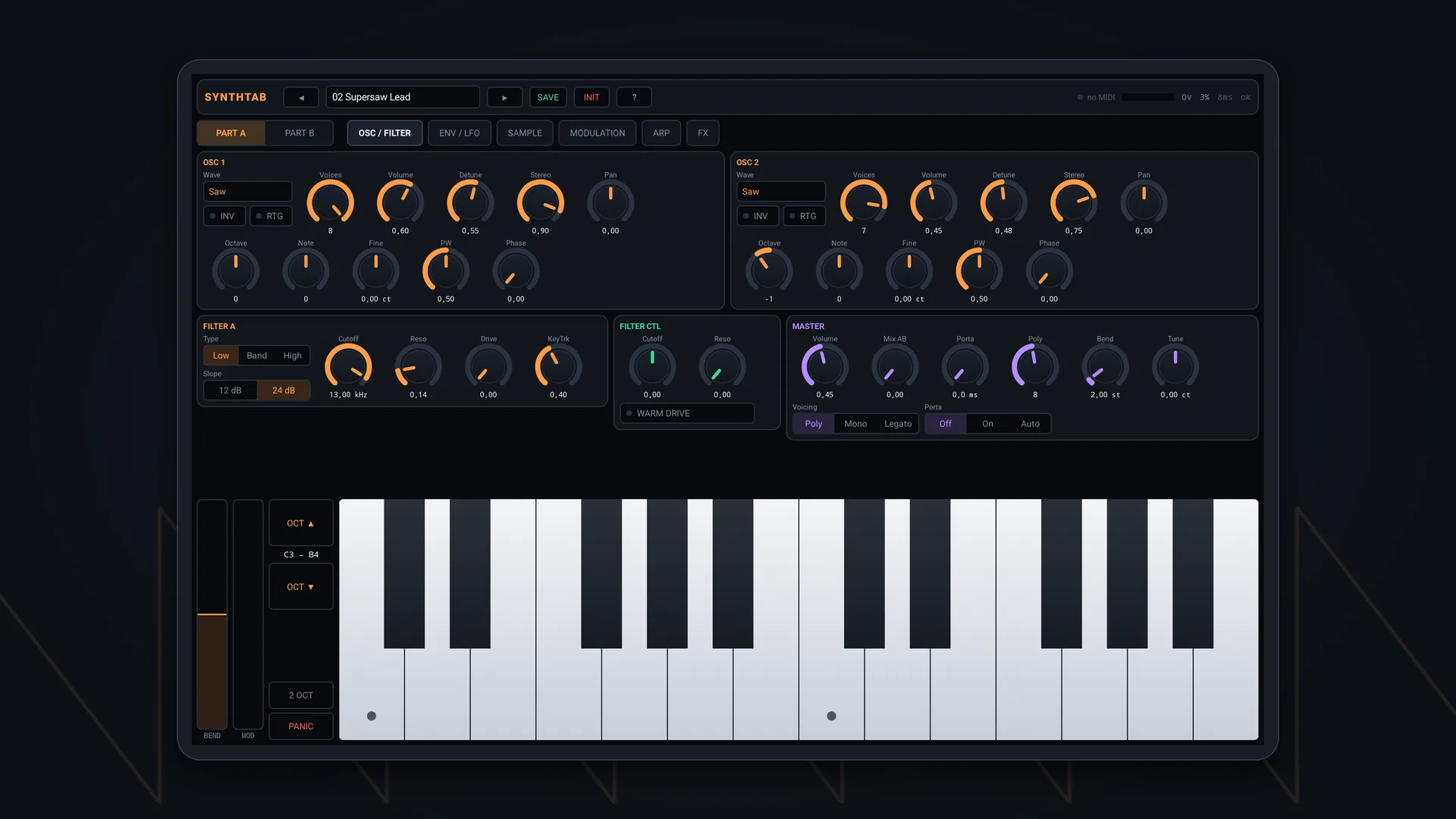
Your recording is just another waveform
Most mobile synths bolt a sampler onto the side. Here Sample and Granular sit in the same waveform list as Saw and Triangle, so a recording inherits eight-voice unison, the ladder filter, both envelopes, the arpeggiator and every one of the 46 modulation destinations.
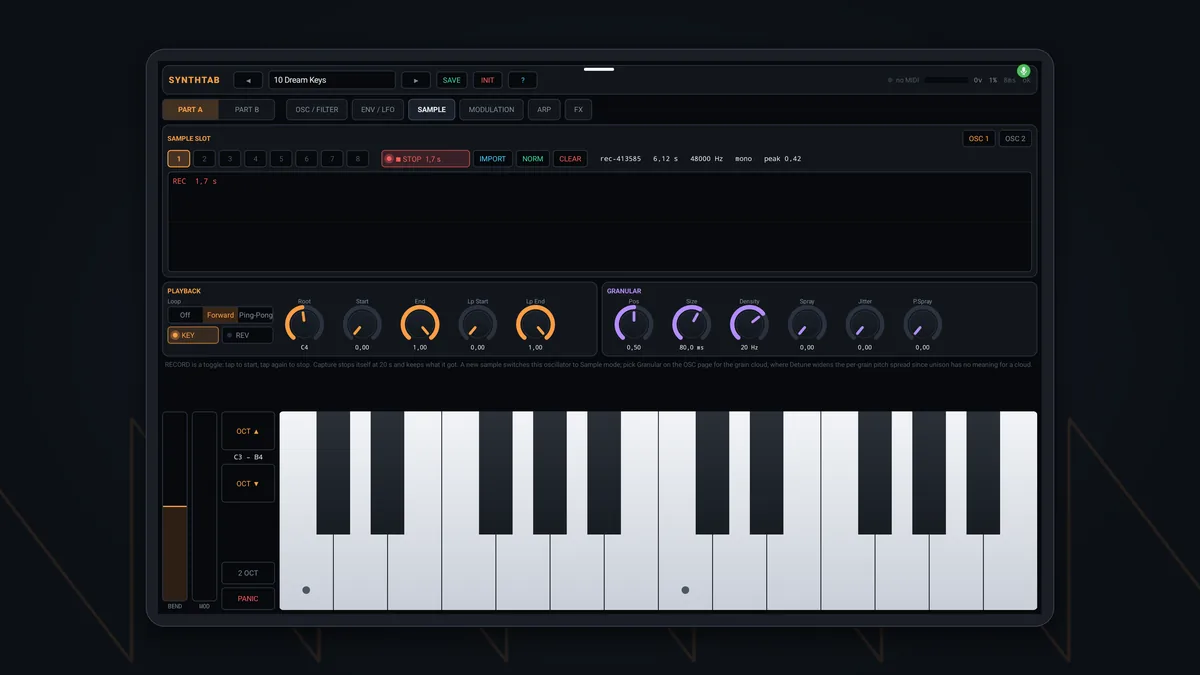
Two taps to record
Hit RECORD, play something, hit it again. The take is normalised, trimmed to where the sound actually starts, and the oscillator switches to Sample mode on its own.
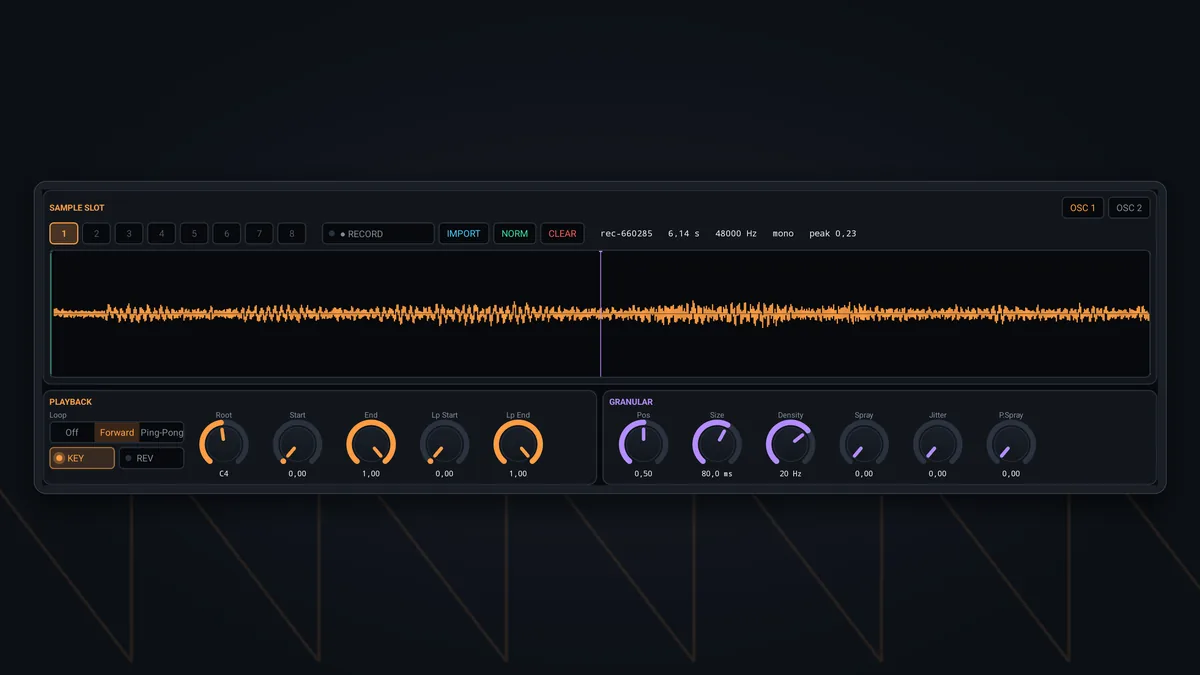
Or scatter it into grains
Grain size from 5 to 500 ms, density, spray, jitter and per-grain detune. Drag the marker across the waveform and the cloud follows your finger.
Not a toy with three knobs
Two independent layers, each a full synth with its own oscillators, filter, envelopes and LFOs. One key can play a two-millisecond pluck and a two-second pad at the same time.
Two per layer, eight voices each
Six waveforms plus your own recordings. Stack up to eight detuned copies of one oscillator for a lead that fills the room.
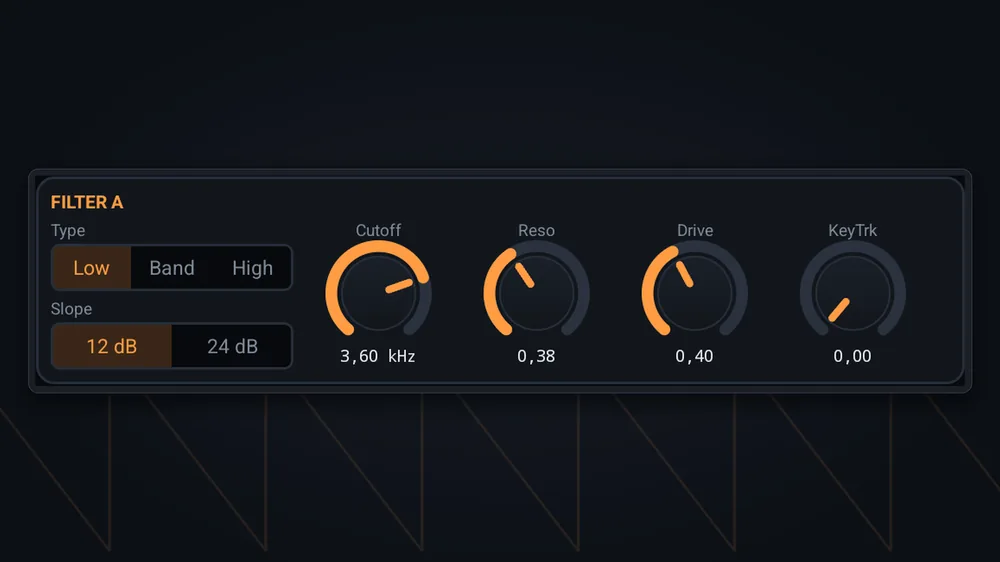
A ladder filter that sings
Low, band and high, 12 or 24 dB per octave, with drive. Push the resonance and it screams; sweep the cutoff and it stays put.
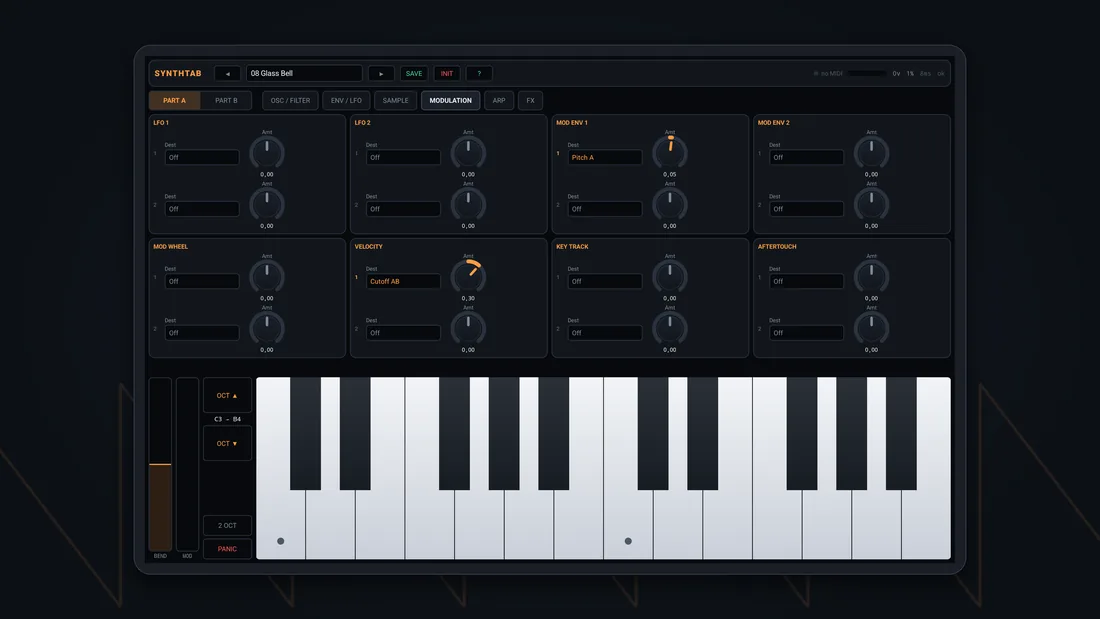
46 destinations
Eight sources with two slots each, reaching across both layers — one layer's LFO can open the other's filter.
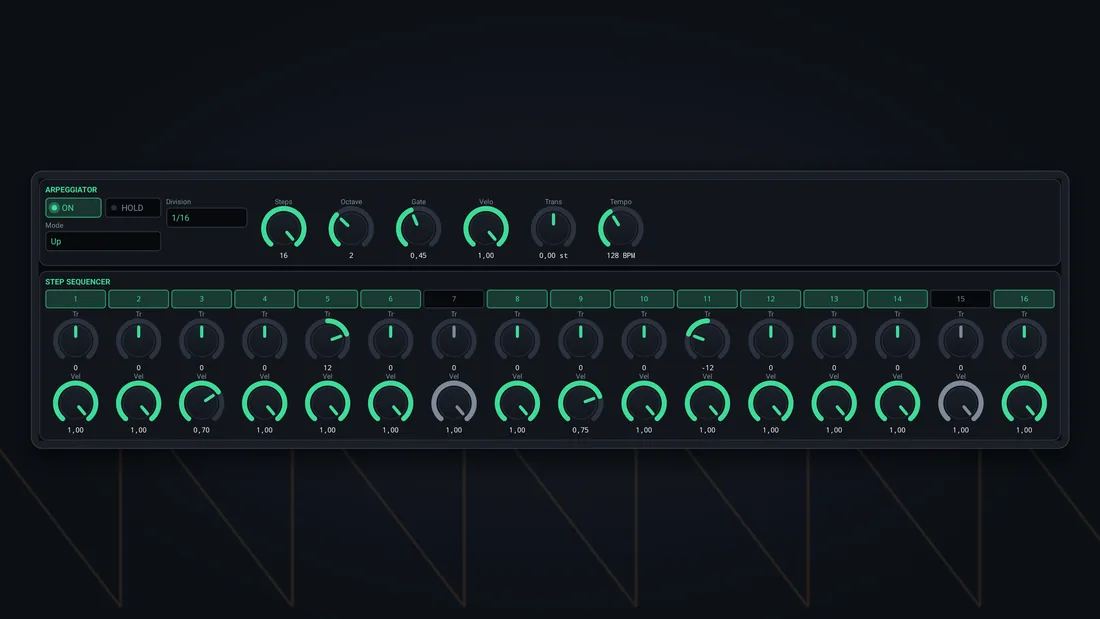
Nine modes, sixteen steps
Per-step gate, transpose and velocity. HOLD keeps a chord running after your hands leave the keys.
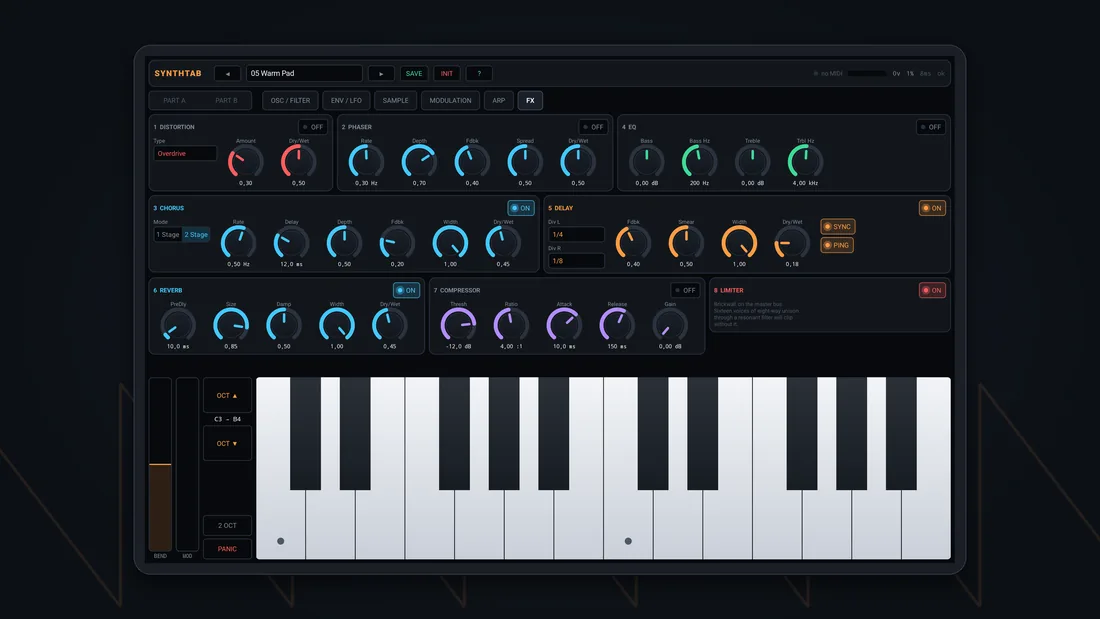
Eight blocks in signal order
Distortion, phaser, chorus, EQ, stereo delay, reverb, compressor and a brickwall limiter on the output.
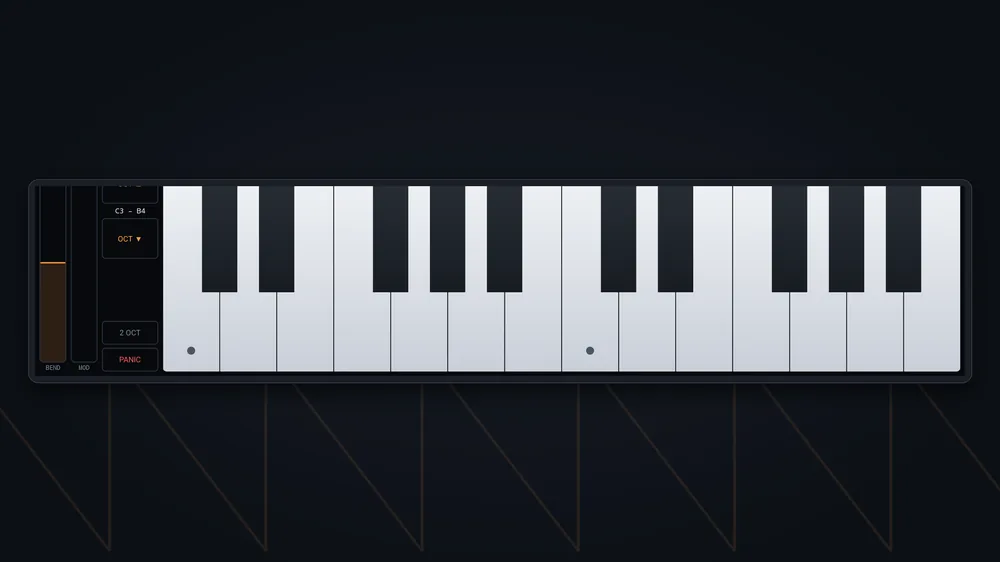
Multi-touch and USB MIDI
Velocity from where your finger lands on the key, pitch and mod wheels, and any class-compliant controller.
It behaves like an instrument, not an app
The numbers that actually matter when you sit down with it. All of them measured on a Galaxy Tab S8+, not estimated.
Pay once. Own it. Play it on a plane.
An instrument should not stop working because a card expired or a server went away. Three things about SynthB are structural, not promises.
One payment, every update
€4.99, once. Every version after this one arrives as an ordinary Google Play update at no extra cost, for as long as the app exists. The purchase is tied to your Google account, so a new tablet does not mean buying it again.
No subscription. No tiers. No in-app purchases. No “pro” unlock. No ads.
Works with the plane on
SynthB does not request the INTERNET permission —
you can check that yourself in the app's permission list before you
trust me on it. Not “offline mode”: the app has no network
code to switch off.
No account, no login, no cloud, no sync, no licence check that can fail in a basement or on a flight.
Nothing about you is measured
No analytics, no crash SDK, no advertising ID, no fingerprinting, no telemetry of any kind. There is nowhere for it to go.
Your recordings and presets are written to the app's private storage and never leave the tablet. Uninstalling deletes them; nobody else ever had a copy.
The one thing that is not us: if you install from Google Play, Google reports its own aggregate install and crash figures to the developer console, as it does for every app on the store. That is Google, and it is anonymised — but it would be dishonest to claim the number zero without saying so. The full detail is in the privacy policy.
And one honest note on fit: this is built for tablets in landscape. It installs and runs on a large phone, but the panels get cramped — you should know that before you pay rather than after.
Bring something to play
Twelve factory presets to start from, eight sample slots waiting, and whatever you can find to record. One payment, every update after it, and it never needs the network.